Thanks for visiting. I love that you're here and looking around, so feel free to read what's here. Take your time.
You may have noticed that I haven't written anything here for a while. I really loved writing this blog but I've moved on to another more general blog called Constant Commoner.
I live in a cabin so that won't change but I write about all kinds of things over there that have nothing to do with where I live. It's about living a life, about writing, about food, about creativity, about anything else that comes up while I'm still breathing.
These posts will still be here, archived now, but any new ones will be at Constant Commoner.
*
*
Every year around this time the trees we commonly refer to as Cottonwoods (but are, in fact, their close cousin Balm of Gilead, according to my "Trees of Michigan" book) send warnings of a cotton storm a'brewing by wafting tiny cotton flakes into the air.
For days we see the cotton building up on the upper branches, knowing that one day when the sun warms the branches enough and the Gods are in their places the "snow" will begin to fly.
This year it started three days ago but then the rains came, stalling the cotton storm for at least a little while. I would say that's a good thing, but it really just prolongs the inevitable. Those cotton bombs are growing bigger and bigger up there and either tomorrow or the next day our side yard is once again going to look like this:
This is a close-up of the cotton ball once it has "exploded":
Early in the spring the "cotton" seeds form and start to fall. They're covered with an incredibly sticky resin and manage to stick to everything, especially the bottoms of our shoes. They end up inside the house, where we have to literally scrape them up off the floor. What a nuisance!
But I've been doing a little research, and it turns out those sticky little buggers are good for something. They can be made into a salve. A balm. A Balm of Gilead. The people who are onto this balm claim it has magical, out-of-this-world qualities. It is a pain reliever, an antibiotic, an anti-itch, anti-inflammatory miracle worker, and, if some others are to be believed, a sure-fire cure for cancer called "black salve".
I found this recipe and this one online, and I can't wait to try making it when it gets cold again and I can gather up those little sticky slivers. Olive oil and beeswax are the main ingredients, and it looks simple enough for even me.
The tree is also called "balsam poplar". They talk about the pleasant aroma, but I can't say I've actually noticed. I'll have to pay attention.
(Oh, by the way, I started this blog yesterday, and today was the day. Our yard looks just like the picture above. I almost took another picture, but you wouldn't have been able to tell the difference. One snowy yard in June looks like any other.)
*
*
So here's the thing: We don't want Geese and Ducks using our beach as a latrine, which they seem to want to do, so we have to come up with ways to discourage them. Bottle rockets may seem extreme to you, but consider this: Our neighbor wants us to shoot the buggers. And if we don't do it, she will. So I have reluctantly agreed to the Bottle Rocket method in order to protect them from Pistol Packin' Grandma, but this time of year I reserve the right to declare a moratorium. (PPG knows about this, too.)
This time of year there are babies out there, and there are enough scary things without us adding to their fears.
This year we've only seen two geese pairs with two babies each. That's unusual and I have to wonder what environmental changes might be taking place now. We're used to seeing eight to ten goslings following behind--at least at first. Over time, either through predation or disease, the numbers dwindle, and I watch sadly as the families grow smaller and smaller.
I'm no expert on geese, but I've been watching these nurseries over the years and I've seen several families swimming together as groups. I have to assume it's for mutual protection. Sometimes the goslings paddle from one family to another and I know it's only a matter of time until one of the parents chases them back to where they belong. There's a bit of a ruckus for a while, with both sets of parents getting their feathers ruffled before they calm down and get back to whatever they were doing. But they are a community--no doubt about it.
Last year I saw this family of Goldeneyes. I had never seen their babies before and this was a thrill:
I'm still waiting to see a mama loon carrying her babies on her back. They don't ordinarily come close to shore, so I may never get the chance. But there's always hope. I keep my camera close, just in case.
I imagine my grandmother has been turning in her grave a lot lately, but this latest travesty must have her positively spinning. She was a true believer in hanging laundry out of doors, even on winter days when they came back inside stiff as boards and steaming from the cold. Even after her daughters decided she was too old to be out there hanging clothes, she refused to use the dryer they installed in the basement. Her one rule was that the last load had to be out on the lines before 10 AM. It was a lazy woman who was still doing her wash in what was practically the middle of the day.
Her reasons for hanging laundry outdoors had more to do with tradition and enjoyment than with saving money or helping the environment. She genuinely looked forward to Mondays, when the washables were scrubbed clean and dried miraculously by nothing but the very air we breathe.
So, while I miss her terribly, I'm glad she isn't here to see this. She simply would not be able to comprehend that there are actually people out there who see clean laundry drying on clotheslines as nothing more than the kind of neighborhood blight that threatens to turn communities into rotting ghettos.
Homeowner's Associations across the country are warning residents that clotheslines and all the attendant paraphernalia, like clothespins and clothespin bags and laundry baskets and actual laundry will not be tolerated in plain sight of other humans.
The debate is getting hot and heavy, even to the point of bringing the blasted gov'mint into it. You can go here to sign a petition stating it is the inalienable right of every man, woman and child to line dry. They're asking for a one day photo-op of the First family airing out their (clean) laundry.
Some states are already working toward rescuing the line dryers from the tyranny of the energymongers. Vermont, for instance, passed the "Right to Dry" for all Vermonters, as described here by Lyman Orton, proprietor of the Vermont Country Store. Lyman has been "raisin' the dickens" about it for the past few years and. . . .but I'll let him tell you:
Colorado, Hawaii, Main, Florida and Utah already have such bills in place, and Maryland, North Carolina, Virginia and Oregon aren't far behind. They're working on it.
Even the New York Times got into it. This from their article: “The issue has brought together younger folks who are more pro-environment and very older folks who remember a time before clotheslines became synonymous with being too poor to afford a dryer,” said a Democratic lawmaker from Virginia, State Senator Linda T. Puller, who introduced a bill last session that would prohibit community associations in the state from restricting the use of “wind energy drying devices” — i.e., clotheslines.
A film crew in the UK is producing a film called, "Drying for Freedom", due in theaters not necessarily near you in 2010. Click here for the trailer.
This is big, folks. But, wouldn't you know? Certain people don't like the idea of anybody telling you you CAN hang out your laundry. They much prefer those who tell you you CAN'T. Tammy Bruce's take on it is this: "You can have my dryer…and washer…and refrigerator when you wring them from my warm, smooth hands." She sees going back to hanging out the laundry as drudgery, and maybe she's right. but what if you just want to?
I have a dryer now, but for the first three years in our cabin, it was air dry or nothing. In the summer I hung laundry outside and in winter I hung them on drying racks, thereby adding needed moisture to the dry heat of a closed-up house.
I still love hanging out when the weather is good. When it's heading toward bad, I often hang out for a while and then throw them into the dryer to finish up. I like the way clothes feel when they've been wind-dried and I like the way they smell. I like the idea of saving a few bucks on electricity, too. And I really like standing out there, clothespins in my mouth (the way my Mom always did), arranging those pieces just so, until they're not only set for optimal drying but are aesthetically pleasing, too. All of the white tee shirts are hung side by side, shoulder to shoulder. The socks match up, heels all facing the same direction. Sometime I even color-code. You can get much more creative with line-drying than you can by throwing things into a dryer. That's a definite plus. (And nobody around here would ever dream of telling me I couldn't.)
But what I especially love about this whole argument is that it's like feathers flying instead of poison-tipped arrows. I haven't laughed so much over a cause I might actually care about in a really long time.
Nature will bear the closest inspection. She invites us to lay our eye level with her smallest leaf, and take an insect view of its plain.
Henry David Thoreau
______________________________________________
This week we were walking along a nearby hiking trail and it might have been the fall light (the air is clearer, the greens are fading, and the vegetation takes on shades of brown and gold), but it seemed like even the simplest bits of nature took on a beauty that just cried out "photo-op".
Stump flowers
A study in Contrasts
Birch Bark
As I was adding those photos to my files, I realized I had taken a lot of pictures lately that might fit into the "walk on by" category. Natural "vignettes" that don't jump out at you, don't leave you breathless, but on closer inspection, have a kind of fascinating beauty.
Tree fungus
A Fungus Bouquet
Lake Superior "seashells"
Caterpillar Chic
Goat's-beard "Puff ball"
The goat's beard, I admit, didn't grow on our dock. The light was better there, and so was the background, so I sort of stuck it in between the dock boards. Artistic license or "fudging". Call it what you will, but I like it!
* * We were buying suet by the wagon-load for a while there, what with the constant stream of uninvited, selfish, messy diners. We had the usual cage suet feeders that attached flat against the trees, and every day they were emptied and needed filling. The squirrels, the black birds, and the pileated woodpeckers made sure there was nothing left for the smaller suet-loving birds, who were hovering nearby licking their chops.
Then I saw something ingenious, either in a catalog or on one of the many blogs I hop to. It showed a suet feeder with the suet cage on the underside. Brilliant! (I would give credit where credit is due, but I honestly don't remember where I saw it.)
I showed it to the fix-it guy around here and he came up with this:
It's just a regular suet cage mounted upside down on a board. The rounded cover made from a soda bottle makes any potential bandit slide right off. It's attached to the tree with an old shelf bracket he had lying around, so the whole thing didn't cost a penny. (Well, maybe a dime, since he had to use a deposit bottle.)
The metal clamp holds the feeder shut and is easy to open when it comes time to fill it again--which isn't nearly as often any more.
The small birds love it and the big, aggressive birds--and squirrels--hate it. That's an added bonus, don't you think?
* * "High horns, low horns, silence, and finally a pandemonium of trumpets, rattles, croaks and cries that almost shakes the bog with its nearness, but without yet disclosing whence it comes. At last a glint of sun reveals the approach of a great echelon of birds. On motionless wing they emerge from the lifting mists, sweep a final arc of sky, and settle in clangorous descending spirals to their feeding grounds. A new day has begun in the crane marsh. . .
. . .Our ability to perceive quality in nature begins, as in art, with the pretty. It expands through successive stages of the beautiful to values as yet uncaptured by language. the quality of cranes lies, I think, in this higher gamut, as yet beyond the reach of words. . .
. . .The sadness discernible in some marshes arises, perhaps, from their having once harbored cranes. Now they stand humbled, adrift in history."
Aldo Leopold, Wisconsin - A Sand County Almanac
************************************
In mid-April, when the ice was just leaving, we were out walking our road and heard strange noises coming from the marshy place around the bend.
Through the bare branches, we saw two sandhill cranes--a rare sight around here.
For once, I had my camera with me and as I started to take pictures, the male of the pair began doing a mating dance. (The pictures are grainy because I was carrying my smaller, less weighty camera with the shorter lens, but I was afraid to get too close and scare them away.)
There is something so primitive about these birds--still so wild and not yet dependent on humans, as the Canada Geese have become. They're rare enough not to be nuisances yet--though in an earlier blog, I posted pictures of hundreds of them in a farmer's field.
That was two years ago, and we haven't seen anything like that again. Now and then we hear their incredibly loud calls and see them flying overhead during the spring fly-0ver, but we are just a stop along the way to a more permanent summer home.
I think I like it that way. I want to be able to be surprised by their calls and to be astonished at their size. I want their numbers to be small enough here so that we humans don't feel the need to try and feed them to keep them around, so that, ultimately, hunters won't feel the need to treat them as nuisances and have an excuse to kill them.
There are elements of wildness that have nothing to do with us--that can survive very well, often better, without us--but that we crave, possibly because something in our primal, primordial past cries out to us. I think it's why so many of us choose to either live in or keep places that are inconvenient at best and crudely inadequate at worst. We crave the quiet and the tranquility of the boondocks, the wildness of nature surrounding us, and we take it where we're able to find it.
Times are desperate here in my sad, beautiful Michigan. State unemployment rates are in the double digits, and I heard a report just this morning that jobless numbers in Detroit are over 24%. Even from this distance--350 miles away and on a separate peninsula--my heart is with those people.
The fear is palpable in the city. Foreclosure notices, red flags on those unfortunate doors, dot every working-class neighborhood and there isn't a person who isn't touched in some way by the current mushrooming joblessness. In Michigan, auto-workers and other blue-collars have always headed north out of the cities to their own little patches of land. You don't have to go far in Michigan to get to where the wild things are, and finding your own quiet breathing space is not a luxury for a factory worker, it's a necessity.
For every lonely hermit who goes quietly mad, a thousand city dwellers--not just in our cities here, but in every city--rage loudly, fiercely, dangerously into insanity. The wilderness, the quiet places, are there to quell that rage, to soothe their fears, to give them respite, even for a few hours or days.
There are people in power who don't understand this need, and I might feel sorry for them if not for the fact that their being clueless often means a surrender of our wild places to corporate interests. Any of us who value these quiet places of inordinate beauty, these sanctuaries for the human soul, cannot let that happen.
"Something will have gone out of us as a people if we ever let the remaining wilderness be destroyed; if we permit the last virgin forests to be turned into comic books and plastic cigarette cases; if we drive the few remaining members of the wild species into zoos or to extinction; if we pollute the last clean air and dirty the last clean streams and push our paved roads through the last of the silence, so that never again will Americans be free in their own country from the noise, the exhausts, the stinks of human and automotive waste." —Wallace Stegner, The Wilderness Letter, written to the Outdoor Recreation Resources Review Commission, 1962 and subsequently in The Sound of Mountain Water (1969)
This has been some spring! Oh, wait. . .it's summer now. Let me just peek outside to make sure. Be right back. . . . .
. . . .okay, I'm kidding. I took these pictures the week after Easter. The eagle landed on the ice, sat there for a few minutes--long enough for me to fiddle with my camera--and then took off.
The ice didn't move out until April 23. We had a ridiculously cold winter up here this year, so looking forward to spring became a full-time occupation. Except spring never arrived. Not in March, anyway. Not in April, either. May looked promising for a couple of days but turns out they were just teasers. Back to endless weeks of cold and wind and fog.
Now it's the end of June (How could that be?), and we've had maybe ten warm days at the most since we got back on the island in mid-April. Week before last we had two HOT days. Into the 80s. But now it feels like April again.
I shouldn't complain, I know. I've looked at those oranges and reds on the Weather Channel's maps and I guess I should be happy the heat waves are missing us. But wind and cold and fog at the end of June doesn't seem at all like summer. I can't believe we're less than a week away from the Fourth of July.
*******************************
We went to the Lower Tahquamenon Falls near the end of April . Plenty of snow in the deep woods and along the shaded boardwalk, but the lookout deck was sunny and clear. Huge runoff this year, making for spectacular rapids. Pictures just can't do justice to the fury of all that water!
Okay, just ignore my grumbling here. There isn't a place on earth I would rather be. The spring bird migration was wonderful. This oriole hung around for almost a week--really unusual. They usually show up one day and are gone the next. They'll hang around hummingbird feeders as long as there is a perch for them. They love oranges, so we hang a half from a nail in a tree. I hear they love grape jelly, too. Maybe I'll try that next year.
The morel mushrooms tried to hide on us, but we found them. Fried them up in a little butter and olive oil and oh, did we go looking for more!
I have a lot of catching up to do after such a long time away. I'll be back!
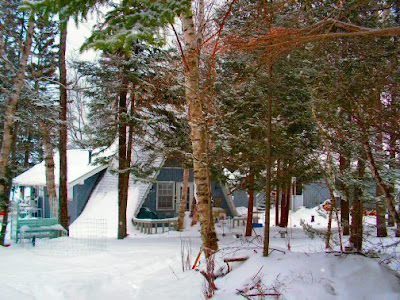
I've been away from our cabin for less than a month, which means that I have more than two months to go before I see it again. In December, when I was packing up to leave, I couldn't wait to start out for new places. We were heading downstate to spend Christmas with the people we care most about, so saying goodbye to our little cabin didn't seem all that hard.
Then, after Christmas, we left our bunch and took off over the Ohio flatlands, beyond the Kentucky hills and into the Smoky Mountains and out the other side to the South Carolina Piedmont, out final destination being the Atlantic coast. It was exciting enough to forget, for a while, about our little cabin in the woods.
Tunnel through the North Carolina mountains
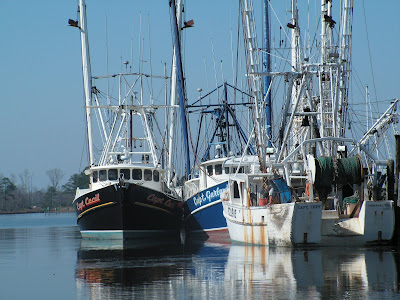
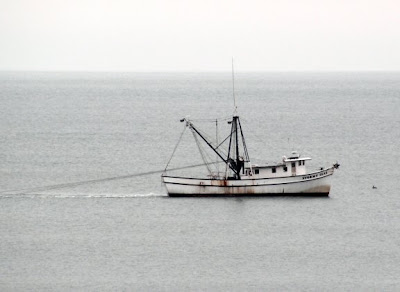
The views are beautiful here, too, though as different as day and night. Instead of pines, we see palms, and instead of Cisco fishermen, we see shrimpers and crabbers pulling their traps into their small boats. The seagulls follow behind, the same as they do on the lakes, but here we see pelicans and the occasional group of dolphins competing for any little morsels left behind or thrown overboard.
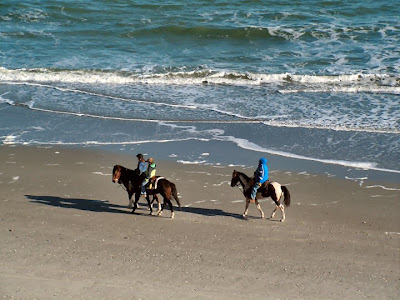
Today there were horses on the beach and I rushed out to take pictures of them. Pretty interesting stuff, so why do I keep thinking about home?
I'm having Cabin Longing at the moment, but I've had Cabin Fever often enough to know it's no fun being cooped up inside a small hut for days on end as Mother Nature unleashes her own nasty brand of Northern fury.
Oh, those furies. . . But that's not what I'm thinking about now. Now all I can think about is a cozy fire in the stove. . .the soup pot simmering on the back burner. . .snowflakes drifting softly, forming luscious pillows outside my window. . .forest creatures stopping by to spend a little quality time with us. . .
. . .Ah, the stuff of dreams. But, oddly, when I shared some of this with the folks near home, they had more than a few choice words, too. Most of which I wouldn't want to repeat here.
Tonight I'm watching the "largest moon of 2009", which might not mean much, considering it's only January 10th, but Nasa says it's a Perigee moon, and I really like the sound of it. This from the Nasa website, where you can read all about it:
Johannes Kepler explained the phenomenon 400 years ago. The Moon's orbit around Earth is not a circle; it is an ellipse, with one side 50,000 km closer to Earth than the other. Astronomers call the point of closest approach "perigee," and that is where the Moon will be this weekend.
Perigee full Moons come along once or twice a year. 2008 ended with one and now 2009 is beginning with another. It's the best kind of déjà vu for people who love the magic of a moonlit landscape.
When I'm up north, much of the time any sky phenomenon is hidden by the ever-present cloud cover, but here at the ocean we've been watching it for over an hour now.
They say it should look largest nearer the horizon, and maybe it did. (See above) But I loved this view, when it was peeking through the clouds.
Did anyone else see it? I'm curious to know whether it looked different in other parts of the country. (Just talked to my daughter in Southeastern Michigan. They got eight inches of snow today, so I'm guessing they weren't watching a full moon!)